What does a home elevator cost consist of? How to build a budget

The first question most homeowners ask is "how much does a home elevator cost?". The honest answer is: it depends on the house. This article shows where the money goes so you can compare quotations fairly.
1. Why there is no single price
Two houses with the same four floors can receive very different quotations, because the price depends on the following factors:
- Number of stops and travel height: more floors mean more landing doors, rails and ropes or screw.
- Load and cabin size: a 3–4 person cabin differs from a 6 person cabin or a wheelchair cabin.
- Drive type: traction, hydraulic, screw-drive or no-counterweight, each with a different configuration and different pit and overhead requirements.
- Finish level: cabin wall, floor and ceiling materials, landing doors, glass or stainless steel.
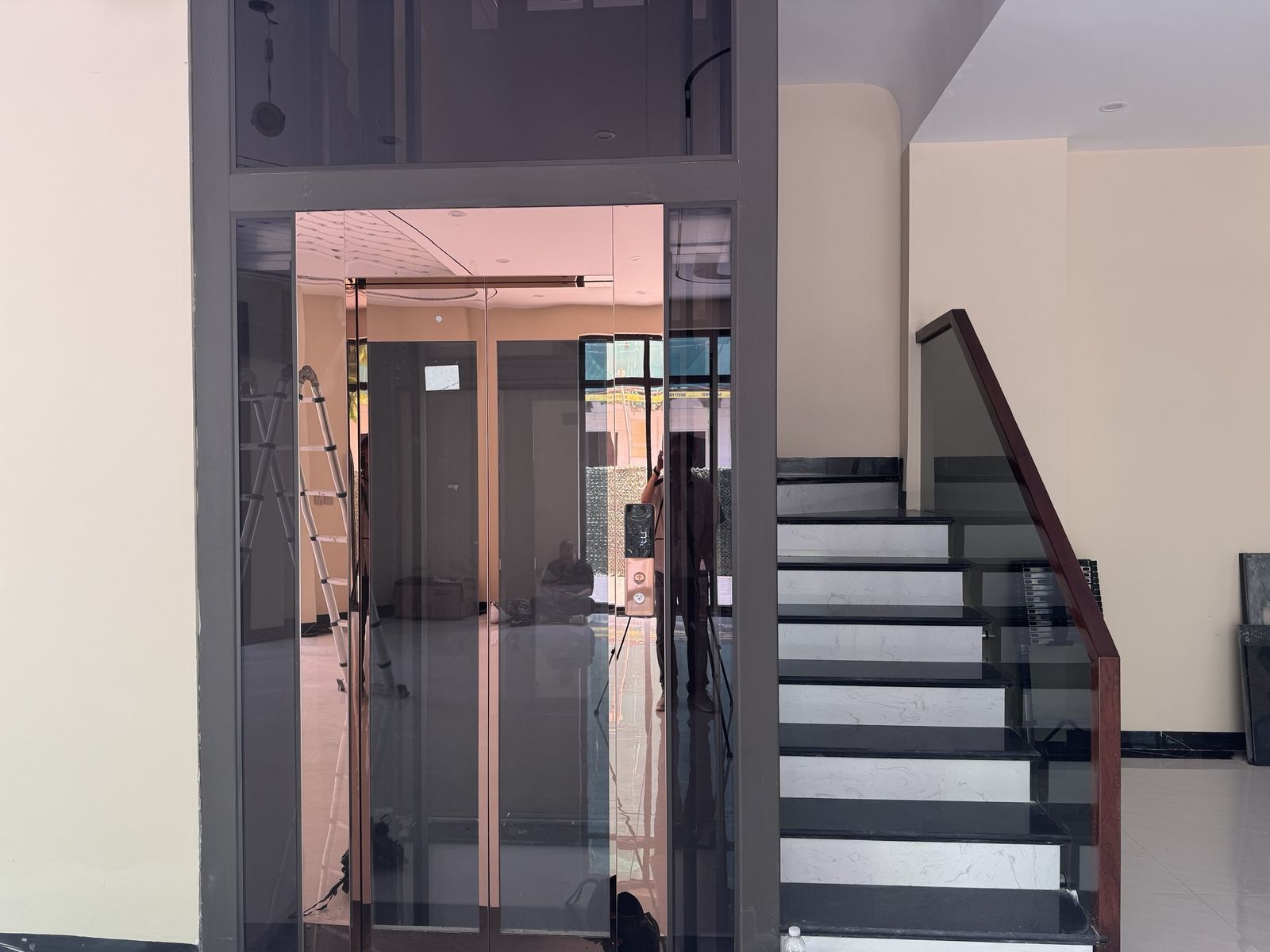
- Site conditions: a new build allows a standard shaft to be designed, while an occupied house must adapt to the available space.
2. Equipment and installation cost
This is usually the largest item in a lift company's quotation. It covers the traction machine or drive unit, controller, guide rails, cabin, landing doors, safety devices, and the labour for installation and commissioning. When comparing quotations, ask exactly what configuration each includes: origin of components, type of traction machine, whether there is automatic rescue during a power cut, and the length of the warranty.
3. Shaft construction cost
Many owners overlook this part because it is usually carried out by the owner or the building contractor and is not part of the lift quotation:
- A shaft in concrete, brick or steel/aluminium frame.
- A pit and overhead (OH) at the dimensions given in the manufacturer's drawing.
- Support beams, hoisting hooks, landing door openings and pit drainage.
If the shaft dimensions are fixed from the design drawings, this item almost never changes. If walls must be broken out and reinforced after the house is built, cost and time rise considerably. See also structure of a townhouse with an elevator and pit and overhead of a home elevator.
4. Inspection, electrical and finishing cost
- Safety inspection before the lift enters service and periodic inspection. See do home elevators need inspection.
- Electrical: power supply, a dedicated circuit breaker, earthing, shaft lighting.
- Finishing: trim around the landing doors, painting, and a roof-level railing if needed.
5. Operation and maintenance cost
After handover the lift has electricity costs (see power use and running cost), regular maintenance and replacement of worn parts. Ask about the maintenance contract in advance: frequency, response time when a fault occurs, and the free warranty period.
6. How to build a budget
- Fix the number of floors and the number of people using the lift at once, then choose the load and cabin size.
- Choose a drive type that suits the structure of the house (new or occupied).
- Ask for quotations with a detailed configuration table from at least two companies, and compare them on the same configuration.
- Add the items a lift quotation does not include: shaft construction, electrical, finishing and inspection.
- Set aside an annual maintenance budget.
ASAHI surveys on site free of charge in Hung Yen and Hanoi, then sends a quotation based on your exact shaft dimensions and chosen configuration.
Frequently asked questions
Does the lift quotation include building the shaft?
Usually not. A lift quotation normally covers equipment, installation and commissioning; the shaft, pit and overhead are built by the construction side. Ask about the scope when you receive a quotation.
Can a lift be installed in a house that is already occupied?
Yes, with suitable models such as aluminium-frame, screw-drive or no-counterweight lifts. A survey is needed to choose the solution and the position.
How do I know if a quotation is expensive or cheap?
Compare on the same configuration: load, stops, machine type, safety devices, warranty and scope of work. Do not compare only the total amount.
- QCVN 32:2018/BLĐTBXH – text of the regulation (Hệ thống pháp luật, in Vietnamese)
- Circular 12/2021/TT-BLĐTBXH – lift safety inspection procedure (LuatVietnam, in Vietnamese)
This article is for general reference. Figures for each project follow the site survey and the lift supplier's drawings; regulations may be updated, so owners should check the original texts.

Engineers who survey and install home lifts at Vinhomes Ocean Park and Vinhomes Global Gate.